
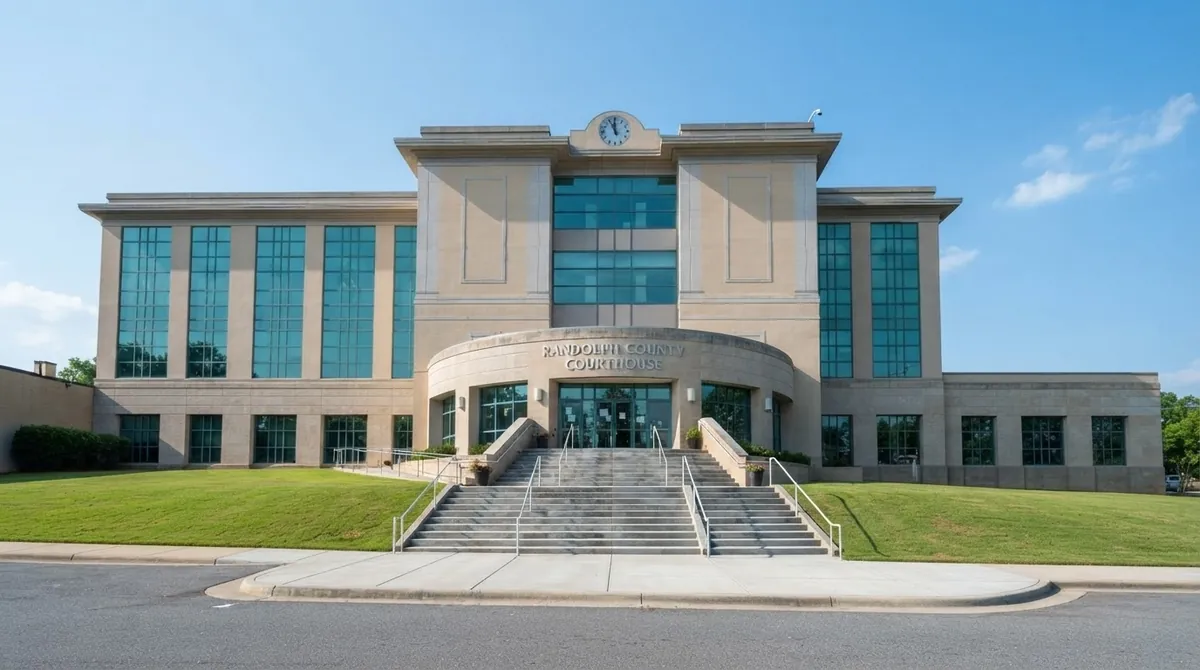
Court records in Randolph County, North Carolina, are maintained by the Clerk of the District Court and are accessible through online tools, official court portals, and directly at the Clerk's office. RandolphCourt.us helps find public information about county court records. Additionally, you can use the North Carolina Judicial Branch portal, visit the Clerk's office, or request public documents through state government resources.
Randolph Court System Overview
Randolph County is part of the 19B judicial district of North Carolina. This district exclusively serves Randolph County. The District Court handles civil and criminal cases, as well as family, probate, and juvenile matters. The Magistrate's division acts as the first tier—magistrates issue warrants, conduct preliminary hearings, and handle small claims.
Randolph County Courthouse is located in Asheboro:
The Superior Court also sits in this courthouse, handling serious criminal offenses and large civil cases.
Courts Serving Randolph
Residents of the county are served by several courts at the state and federal levels.
State Courts
Federal Court
Bankruptcy cases are handled by the U.S. Bankruptcy Court for the Middle District of North Carolina at the same address.
Municipal Courts
North Carolina does not have a separate municipal court system. Violations of city ordinances, including in Asheboro, fall under the jurisdiction of the District Court. The Asheboro Police Department forwards cases directly to the district court system.
What Types of Cases Randolph Courts Hear
The county courts handle a wide range of cases. Here are the main categories:
- Felonies and misdemeanors
- Traffic violations and infractions
- Civil lawsuits, including small claims
- Family law: divorce, custody, alimony
- Probate cases, guardianship, conservatorship
- Juvenile cases and child protection matters
- Adoptions
Details on each category are in the following sections.
District Court Cases in Randolph
The District Court in Randolph County handles criminal misdemeanors, DWI cases, and some felonies at the preliminary hearing stage. The District Court judge also handles civil cases with claims up to $25,000, family disputes, custody cases, and probate matters. Appeals from the Magistrate's Court on small claims are heard here.
The Superior Court, which sits in the same courthouse, takes serious criminal cases after preliminary hearings and civil claims over $25,000. Cases are assigned to judges through the county's administrative system. The presiding judge sets the court schedule, and the court clerk is responsible for case management and document storage.
Magistrate Court Cases in Randolph
Magistrates in Randolph County perform several key functions. They issue arrest and search warrants, set bail, and conduct preliminary hearings in felony cases. Small claims up to $10,000 fall under their direct jurisdiction.
Magistrates also handle:
- Eviction claims
- Applications for protective orders (initial stage)
- First hearings in DWI cases
The Magistrate's Office in Archdale serves the southern part of the county. Magistrate decisions on small claims can be appealed to the District Court, where the case will be heard anew.
Family Law, Probate, and Juvenile Matters in Randolph
Family Law. Divorce, child custody, alimony, protective orders, and paternity establishment are all handled by the District Court. Divorce certificates can also be obtained through NC Vital Records or at the Clerk's office in the county where the divorce was filed.
Probate Matters. The Clerk of Randolph County acts as the probate judge—a feature of the North Carolina system. They handle wills, appoint executors, and approve guardianship and conservatorship. You can contact the Clerk's office directly.
Juvenile Matters. Juvenile cases are confidential under state law. The District Court handles juvenile delinquency and child protection cases. For information on juvenile services, contact the Clerk's office at (336) 328-3000.
How Cases Move Through the Randolph Court System
- Case Initiation. A criminal case begins with a complaint or warrant; a civil case starts with a complaint filed with the court clerk. Family and probate cases are initiated by petition.
- Judge Assignment. The court administrator assigns cases to judges based on type and court schedule.
- Initial Hearings. In criminal cases—arraignment. In civil cases—a scheduling conference or preliminary hearing.
- Pre-Trial Stage. Parties exchange evidence (discovery), file motions, and negotiate plea deals or settlements.
- Case Resolution. A jury or judge delivers a verdict. Alternatives: plea deal, settlement, default judgment.
- Post-Judgment. Sentencing, appeal filing, or enforcement of the court's decision.
Check case status and hearing dates through the North Carolina Judicial Branch portal.
Court Administration, Local Rules, and Public Access in Randolph
The 19B district courts are managed by the administrative district judge along with the court administrator. Local court rules are published on the Randolph County page on the NC Judicial Branch website.
Regarding public access to records:
- Most court records in North Carolina are public under the State Public Records Law (N.C.G.S. Chapter 132).
- Confidential records include: juvenile cases, adoption cases, sealed or expunged records.
- Paper records can be viewed by visiting the court clerk's office in the county where the case is filed. Copies are available for a set fee.
Hearings are generally open to the public. For remote participation options, contact the Clerk's office at (336) 328-3000.
Court Records and Related Court Resources in Randolph
- Online Case Search. The NC Judicial Branch portal allows searching for records, hearing dates, and making payments.
- Obtaining Court Records. Detailed instructions are available on the Court Records page—here, the procedure for background checks, obtaining copies, and expunging records is described.
- Randolph County Inmates. The Sheriff's Office publishes a list of inmates by date and by name.
- State Offender Search. The NC Department of Adult Correction provides information on individuals in state prisons and on parole.
- Public Records Requests. The NC DAC online form directs requests regarding criminal and civil cases to the appropriate agencies.
- Vital Records. NC Vital Records issues birth, death, marriage, and divorce certificates. These documents are not free.
- Property Records. The Randolph County Property Search displays current tax system data. The county GIS portal allows searches by owner, address, or parcel description.
- Archival Records. The North Carolina State Archives holds historical documents, including old court materials.